
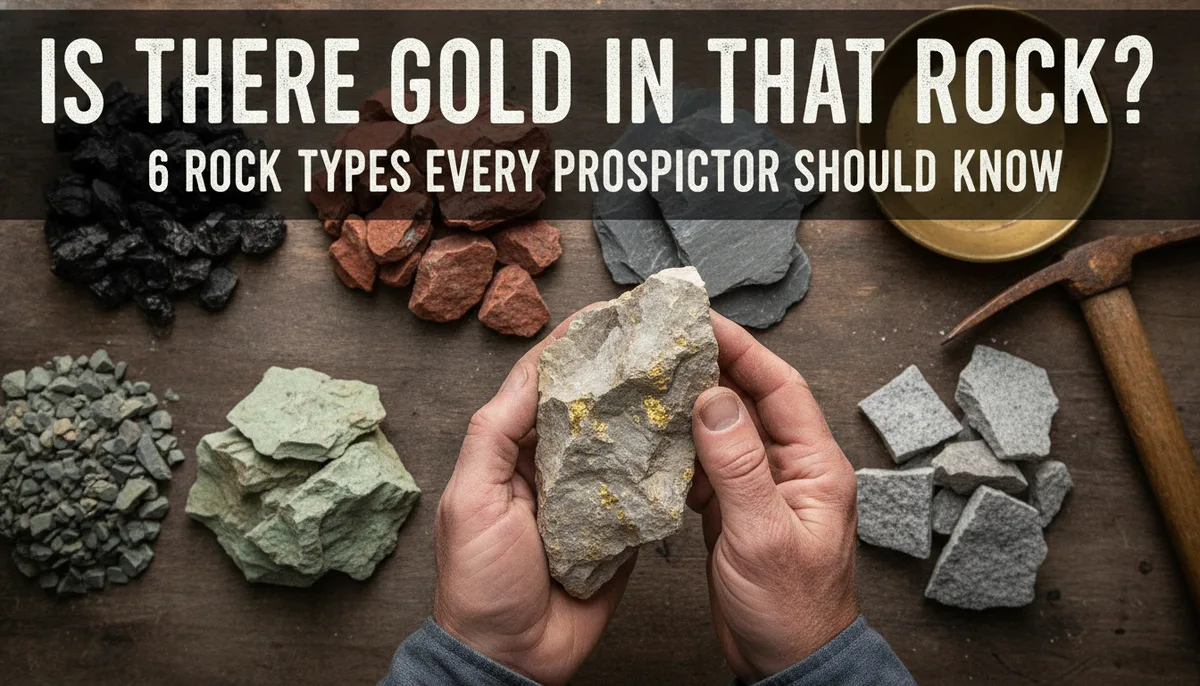
Is There Gold in That Rock? 6 Rock Types Every Prospector Should Know
The Hidden Wealth Beneath Your Feet
It is a universal human instinct to pick up a heavy, glittering stone and wonder if it might be more than just a common rock. For rockhounds and amateur prospectors, the dream of "striking it rich" often starts with a single specimen found in a creek bed or an old tailing pile. However, gold rarely presents itself as a giant, shiny nugget sitting on the surface. More often, it is microscopic or encased deep within a host rock, waiting for a keen eye to identify the geological markers.
Understanding which rocks are likely to contain gold is the difference between a productive day in the field and a long walk with a heavy backpack full of common gravel. Gold is a rare element, but it follows specific geological rules. By learning to recognize the six primary rock types and formations that host gold, you can significantly increase your chances of finding the real thing.
1. Quartz: The Primary Indicator
If you ask any seasoned prospector where to look for gold, the first word out of their mouth will likely be "quartz." Quartz is the most common host for lode gold. This relationship exists because of how gold is transported from deep within the Earth’s crust.
Hydrothermal Veins and Mineralization
Gold is typically carried toward the surface by superheated, mineral-rich water. As these hydrothermal fluids cool and the pressure drops, the minerals crystallize. Quartz is one of the most stable minerals to form in these conditions, often filling the cracks and fissures in the surrounding "country rock." As the quartz solidifies, the gold precipitates out of the fluid and becomes trapped within the quartz structure.
What to Look For: "Rusty" vs. "Bull" Quartz
Not all quartz is created equal. Pure, milky white quartz—often called "bull quartz" by miners—is frequently barren. While it looks beautiful, it often lacks the mineral complexity required to host gold.
Instead, look for quartz that appears "dirty," "rotten," or "rusty." This reddish-brown staining is caused by the oxidation of iron-rich minerals like pyrite. When the iron leaches out, it leaves behind small pits or "vugs." These cavities are the perfect hiding places for gold. If you find quartz with heavy iron staining and a crumbly texture, you are looking at a prime candidate for gold mineralization.
30x jeweler's loupe for rock ins...
2. Sulfide Minerals: The "Fool's Gold" Connection
Gold is chemically "sociable"—it likes to hang out with other minerals, particularly sulfides. The most famous of these is pyrite, or "Fool's Gold." While it can be frustrating to find a glittering vein of pyrite only to realize it isn't gold, don't throw the rock away just yet.
Pyrite and Arsenopyrite
In many gold-producing regions, gold is physically or chemically bound within pyrite and arsenopyrite. This is known as "refractory gold." Even if you cannot see the gold with a magnifying glass, the presence of heavy sulfide mineralization is a major indicator that gold is nearby.
When searching for sulfides, look for:
- Brass-yellow cubes: Typical of pyrite.
- Silvery-gray, needle-like crystals: Typical of arsenopyrite.
- Dark, heavy metallic streaks: Indicators of complex mineral sulfides.
If you find a rock heavy with these minerals, it may be worth crushing a small sample to see if any "free-milling" gold is released.
3. Metamorphic Rocks: Schist and Gneiss
Metamorphic rocks are formed when existing rocks are subjected to intense heat and pressure, causing them to change physically and chemically. This process often occurs during mountain-building events, which are also the primary drivers of gold mineralization.
The Role of Pressure
Rocks like schist and gneiss are often found in "greenstone belts," which are legendary among gold prospectors. The intense pressure that creates schist also creates the fractures necessary for gold-bearing quartz veins to form.
In these formations, gold is often found at the contact points—where the quartz vein meets the metamorphic rock. These "contact zones" are high-priority areas for sampling. The dark, foliated (layered) structure of schist provides an excellent contrast, making it easier to spot the bright white of a gold-bearing quartz vein cutting through the layers.
4. Igneous Rocks: Granite and Diorite
Igneous rocks, formed from the cooling of molten magma, are the ultimate source of most gold. While you are unlikely to find a nugget sitting in the middle of a solid block of granite, the edges of these massive "plutons" are gold-hunting hotspots.
Magmatic Differentiation
As a large body of magma cools, gold and other heavy metals stay in the liquid phase longer than the common minerals that make up granite. This concentrated "leftover" liquid is eventually pushed into the surrounding rock, forming the hydrothermal veins we discussed earlier.
When prospecting in igneous terrain, look for "dikes"—narrow bands of a different type of rock (like pegmatite or diorite) cutting through the main granite body. These dikes represent the last stages of volcanic activity and are much more likely to carry concentrated gold than the surrounding host rock.
5. Sedimentary Rocks: Conglomerates
While gold is born in heat and pressure, it is often found in the cold, wet environments of ancient riverbeds. Over millions of years, gold-bearing rocks erode, and the heavy gold is washed into streams. Eventually, these stream beds can be buried and turned into a type of sedimentary rock called conglomerate.
"Pudding Stone" Gold
Conglomerates look like a natural form of concrete, consisting of rounded river stones cemented together by a finer silt or sand. In the prospecting world, these are often called "pudding stones."
Because gold is so heavy, it settles in the same places as the large cobbles and pebbles in a river. If an ancient river was carrying gold, that gold is now trapped in the "cement" between the stones of the conglomerate. Some of the world’s largest gold deposits, such as the Witwatersrand in South Africa, are found in these ancient sedimentary layers.
Estwing rock pick hammer for fie...
6. Volcanic Rocks: Rhyolite and Andesite
Not all gold comes from deep-seated veins. "Epithermal" deposits form much closer to the surface, often associated with hot springs and volcanic vents. These deposits are frequently hosted in volcanic rocks like rhyolite and andesite.
Low-Sulfide Gold
In these volcanic environments, the gold is often extremely fine—sometimes so fine it is invisible to the naked eye. However, it is often associated with "chalcedony," a waxy, translucent form of quartz. If you find volcanic rocks that look "bleached" (turned white or pale yellow by acidic volcanic gases) and contain bands of chalcedony, you may have found an epithermal gold system.
How to Test Your Finds
Finding a promising rock is only the first step. Once you have a specimen, you need to determine if that glitter is truly gold.
The Scratch and Streak Test
Gold is a very soft metal (2.5 to 3 on the Mohs scale). If you poke a piece of gold with a sharp needle, it will dent or deform. Pyrite, on the other hand, is brittle and will shatter into powder.
Furthermore, you can perform a streak test using a piece of unglazed porcelain. Real gold will leave a golden-yellow streak. Pyrite will leave a greenish-black streak, and hematite (which can sometimes look like dark gold) will leave a reddish-brown streak.
Cleaning Your Specimens
Before you can properly evaluate a rock, it needs to be clean. For many rockhounds, the goal isn't just to find gold to sell, but to find a beautiful "specimen gold" piece for a collection.
If you are interested in the broader hobby of rock collecting and want to make your finds look their best, you might consider the mechanical cleaning process. For beginners, understanding how to process rocks is key. Check out The Polished Pebble Master Buying Guide: Choosing Your First Rock Tumbler to learn how to turn rough field samples into display-quality pieces. While you wouldn't typically tumble a gold specimen (as it could wear away the soft gold), the principles of mineral identification and preparation are essential for any rock seeker.
Practical Steps for the Field
- Research the History: Gold is rarely found in places where it has never been found before. Look for geological surveys and historical mining records for your area.
- Follow the Water: Even if you are looking for lode gold (in rocks), start in the creeks. Follow the "float" (loose rocks washed downstream) up the mountain until the gold disappears. This is likely where the source vein is located.
- Check the "Contact Zones": Always look at the boundaries where two different types of rock meet. This is where the geological "action" happens.
- Sample and Crush: If a rock looks promising, take a sample. You can use a heavy mortar and pestle to crush the rock into a fine powder and then pan it out just like you would with stream gravel.
heavy duty cast iron mortar and...
Final Thoughts: The Value of the Search
Whether you find a life-changing nugget or just a few "colors" at the bottom of your pan, the process of identifying gold-bearing rocks connects you to the Earth in a unique way. It requires patience, a sharp eye, and a basic understanding of the titanic forces that shaped our planet.
If you find that your interest in rocks extends beyond just gold, you may find the process of professional polishing rewarding. To learn more about the technical side of refining your finds, read our guide on The 4 Stages of Grit: A Simple Guide to Professional Rock Polishing.
Remember, the "gold" is often in the journey and the knowledge you gain along the way. Happy hunting!