
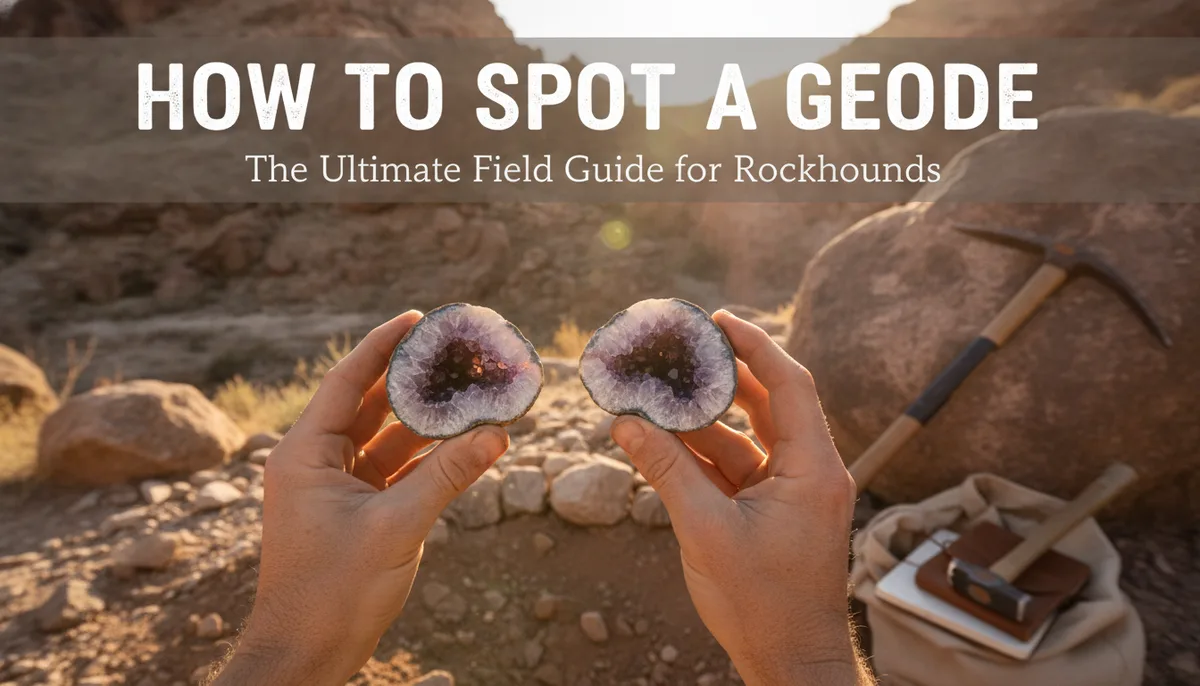
How to Spot a Geode: The Ultimate Field Guide for Rockhounds
Finding a geode is often described as the ultimate "treasure hunt" for geology enthusiasts. On the outside, a geode looks like nothing more than a mundane, lumpy, or mud-covered stone. However, hidden within that unassuming exterior lies a world of sparkling quartz, deep purple amethyst, or delicate calcite formations.
The challenge for any rockhound is knowing which stones to bring home and which to leave in the creek bed. Cracking open every round rock you find is exhausting and often disappointing. By understanding the specific physical characteristics, weight ratios, and geological contexts of these specimens, you can significantly increase your success rate.
The Science of the "Hollow Rock"
To identify a geode effectively, you must first understand what it actually is. A geode is a secondary geological structure which forms within sedimentary or volcanic rocks. They begin as a cavity—essentially a bubble in lava or a hollow left by decaying organic matter or dissolved minerals in sedimentary layers.
Over millions of years, mineral-rich groundwater seeps through the porous outer shell of the cavity. As the water evaporates or the chemistry changes, minerals (most commonly silica) precipitate out, forming layers of crystals that grow inward toward the center. If the process is interrupted, the center remains hollow, which is the hallmark of a true geode.
If the cavity is completely filled with mineral matter, it is technically referred to as a "nodule." While nodules can be beautiful, they lack the classic "crystal cave" aesthetic that makes geodes so desirable.
The Weight Test: The Most Reliable Indicator
The single most effective way to tell if a rock is a geode is to test its weight. Because a geode is partially hollow, it should feel surprisingly light for its size.
When you pick up a rock that you suspect is a geode, compare it mentally (or physically, if you have a known solid rock nearby) to a piece of granite or basalt of similar dimensions. If the stone feels dense and heavy, it is likely a solid nodule or an ordinary river cobble. If it feels "airy" or lighter than its volume suggests, there is a high probability that it contains a hollow center.
Experienced rockhounds often use a "heft" technique. By gently tossing the rock a few inches into the air and catching it, you can gauge its density more accurately than by simply holding it. A geode will feel "empty" in its momentum.
Identifying Surface Texture and Shape
Geodes rarely look like the polished, sliced versions you see in museum gift shops. In the wild, they are camouflaged by millions of years of weathering. However, there are three key visual cues to look for:
The "Cauliflower" Texture
One of the most distinct features of a geode is its exterior texture. Many geodes, particularly those found in limestone regions, have a bumpy, "cauliflower-like" surface. These protrusions are the result of the hard, mineralized outer shell resisting erosion more effectively than the surrounding host rock. If you see a rock that looks like it is covered in small, rounded warts or bumps, it is a prime candidate for a geode.
Spherical or Oblong Symmetry
While river rocks are often smoothed into flat ovals by the flow of water, geodes tend to maintain a more spherical or egg-shaped profile. Because they formed within a gas bubble or a spherical pocket, they usually retain that rounded geometry.
The Distinction from Thundereggs
It is easy to confuse geodes with thundereggs, especially in volcanic regions. While they share some similarities, thundereggs are almost always solid and feature distinct "rhyolitic" shells. For a deeper dive into these specific formations, see our Unveiling Nature’s Hidden Gems: The Complete Guide to Thundereggs.
Acoustic Testing: The "Tap Test"
If the weight and texture leave you uncertain, you can use sound to help identify a hollow interior. This is known among collectors as the "Tap Test."
Using a small rock hammer or even another hard stone, gently tap the specimen. A solid rock will produce a sharp "clink" or a dull "thud." A geode, because of the internal void, will often produce a slightly resonant or "hollow" sound. This isn't always as obvious as a ringing bell, but with practice, you can distinguish the subtle difference in vibration.
Be careful not to tap too hard, as you don't want to crack the specimen prematurely in the field, which can lead to contamination of the crystals with dirt and mud.
Estwing 22 oz Rock Pick with Poi...
Where to Look: Geological Context
You won't find geodes just anywhere. They are geographically concentrated in areas with specific geological histories.
- Volcanic Ash Beds: Regions with ancient volcanic activity are prime geode territory. The gas bubbles in cooling lava provide the perfect "mold" for geode formation.
- Limestone and Dolomite Deposits: In sedimentary environments, geodes often form in cavities where fossils or salt crystals have dissolved away. The Midwest United States (particularly Iowa, Illinois, and Missouri) is world-famous for its "Keokuk" geodes found in these layers.
- Dry Riverbeds and Deserts: Erosion often washes geodes out of their host rock and deposits them in creek beds. Desert pavement areas are also excellent for spotting the cauliflower texture of weathered geodes.
If you are hunting in an area known for gold or other heavy minerals, it is important to distinguish between the various types of "heavy" vs "light" rocks you might encounter. For more on identifying different mineral-bearing stones, check out Is There Gold in That Rock? 6 Rock Types Every Prospector Should Know.
Tools for Discovery and Extraction
To successfully find and identify geodes, you need a basic kit. Carrying the right tools ensures you can extract specimens without damaging the fragile internal structures.
- Rock Hammer: Essential for the "Tap Test" and for prying geodes from host rock.
- Chisel: A flat-head masonry chisel is vital for controlled opening.
- Safety Goggles: Geode shells are often made of chalcedony or quartz, which can shatter into razor-sharp shards. Never strike a rock without eye protection.
- Sturdy Backpack: Even "light" geodes add up in weight quickly during a long hike.
Ironarm Rock Pick Hammer and Min...
How to Open Your Find Properly
Once you’ve identified a potential geode, the temptation is to smash it open immediately. However, a brute-force approach often results in a pile of small, useless fragments rather than two beautiful halves.
The Hammer and Chisel Method
This is the most common field method. Place the geode on a soft surface (like sand or a patch of grass) to absorb the shock. Place your chisel in the center of the rock and tap it gently with your hammer. Rotate the geode and continue tapping in a line around the circumference. Eventually, the rock will "score," and a final, firmer tap will cause it to pop open along the line.
Using a Pipe Cutter
For the cleanest possible break, many professional rockhounds use a chain-style soil pipe cutter. The chain is wrapped around the geode and tightened until the pressure causes the rock to snap perfectly in half. This method preserves the crystal points much better than a hammer.
The Lapidary Saw
If you suspect the geode is filled with high-quality agate or delicate crystals, using a diamond-bladed lapidary saw is the gold standard. This allows you to see a cross-section of the formation and creates a flat surface that is much easier to polish.
If you decide to polish your find to a mirror finish, understanding the progression of abrasives is key. You can follow our guide on The 4 Stages of Grit: A Simple Guide to Professional Rock Polishing to learn how to turn a raw geode into a display-ready masterpiece.
Conclusion
Identifying a geode is a skill that combines scientific knowledge with sensory intuition. By looking for the tell-tale "cauliflower" bumps, feeling for that surprising lightness, and listening for a hollow resonance, you can transform your next outdoor adventure into a successful treasure hunt. Remember that every geode is a time capsule, preserving mineral processes that occurred millions of years ago. Whether you find a simple quartz-lined cavity or a rare amethyst-filled wonder, the thrill of being the first human to ever see the crystals inside is a reward like no other in the world of rockhounding.